
Research and Examinations of My Own Work
This is where I publish research that no client commissioned, and examinations of my own work: what held, what did not, and why. Each piece opens on its own page, and every series I write is listed below. For the newest shorter articles, go to Perspectives.
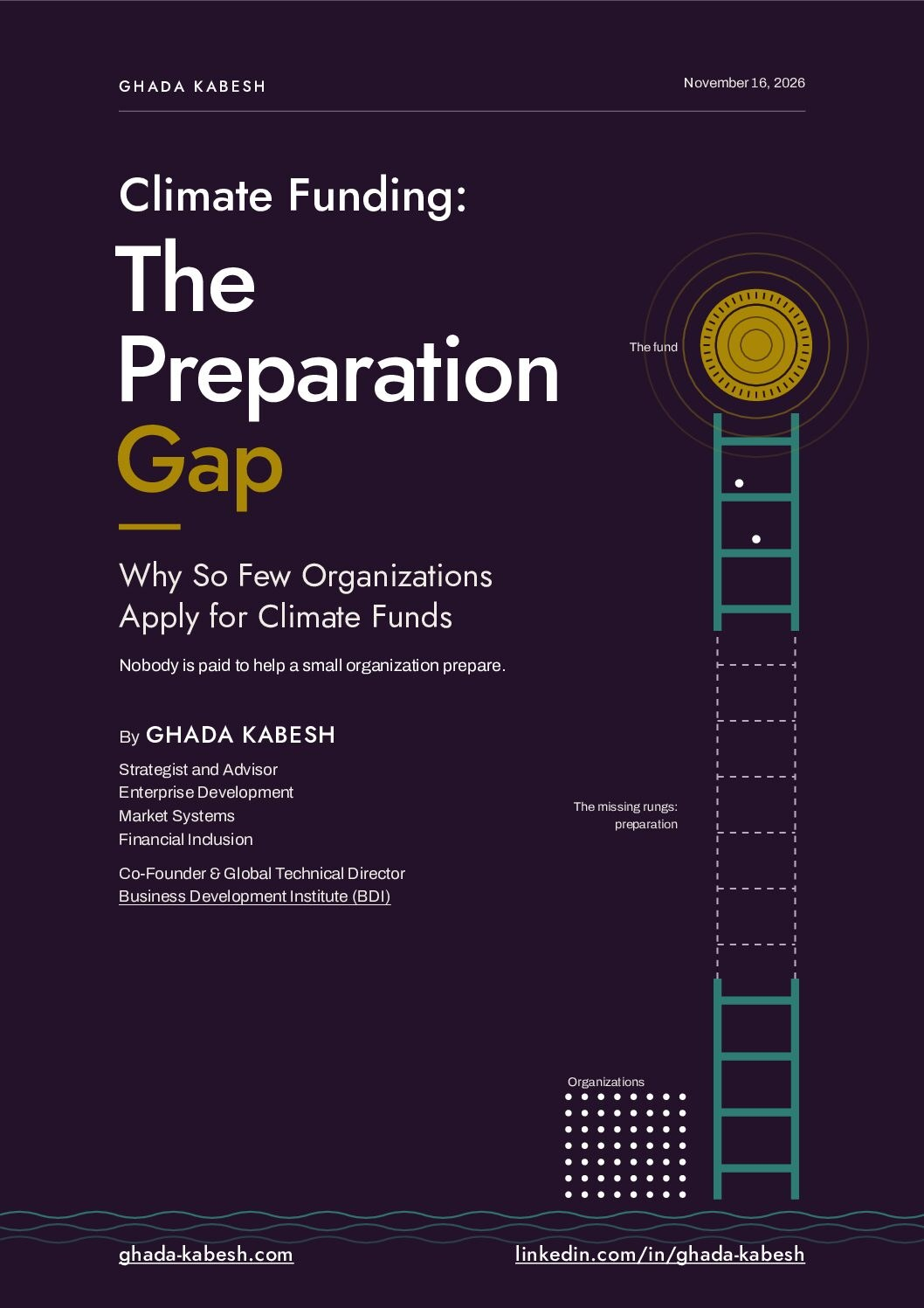
Climate Funding: The Preparation Gap
Why So Few Organizations Apply for Climate Funds
Climate funds say they want local organizations, yet cooperatives, community groups and small firms rarely get as far as an application. After reading the evidence on awareness, process, cost and design, I think the missing piece is a service, not a message: nobody is paid to help a small organization prepare.
Numbered long reads. Each piece takes one case from my own work and examines it at four levels: the event, the pattern behind it, the structure that keeps it in place and the belief underneath.
Why Good Development Consultants Are Not Getting Hired
The buyers did not disappear. They changed what they buy. What wins work for development consultants now, read from both sides of the table since 2014.
The Monday After the Training
A course ends on Friday. Whether anything changes is decided on Monday, by a manager, a calendar and a reporting tool the trainer never sees.
Evaluating Financial Inclusion Programs: What Reports Keep Missing
Financial inclusion programs are counted well and evaluated rarely. Three things endline reports keep missing: usage, who delivers after the program, and the norm behind the number.
Investment Readiness in MENA: Ready for Whom?
Investment readiness is usually treated as something a founder has. In MENA, it behaves more like something a market has, and the market keeps changing.
Reading an MFI’s Portfolio Before You Fund Its Growth
I have read MFI portfolios from the inside and from the funder’s side. A growth line is an answer. Before funding it, ask what the question was, and read four things first.
What a Market Systems Diagnostic Should Tell a Donor Before Design Starts
I have worked on three donor programs that set up Business Development Services units inside host institutions. Some units did not outlast the programs. In each case the diagnostic came after the design, so it was asked to confirm the plan, not to test it.
The Repayment Schedule Is the Intervention
A systems reading of one of the most common failures in microfinance and MSME lending, and why the fix is rarely where institutions look for it.
Short practitioner notes. Each one takes a single design problem and makes one point about it, with the practical move that follows.
What I See in the First Two Pages of a Losing Proposal
After 25 years in international development, the seven checks I run on the first two pages of a proposal, and two newer patterns that fail them.
Ask the AI, Then the Client: The Five-Question Check
Five questions to ask a small business owner after any AI diagnostic, with what each one catches and what to do next. Save it for your next client session.
AI That Does Not Speak the Client’s Language
Arabic is spoken by more than 500 million people and makes up about 0.7 percent of global URLs. In AI-enabled business development services, language is part of the design.
Youth Enterprise Funds: When the Eligibility Rule Writes the Portfolio
When a youth fund’s only real filter is a credit score, the portfolio follows the score.
Systems thinking for practitioners, in short episodes.
Below the Waterline: Systems Thinking for Practitioners
One systems concept per episode, from loops and delays to leverage points, applied to a real case from MSME finance or enterprise support.
Pieces that unpack the sector’s big words and test what each one actually measures.
SDG, ESG and Impact: Three Words, Three Different Questions
SDG alignment, ESG scores and impact claims are used as if they meant the same thing. They answer three different questions, for three different readers. Mixing them is how reports get greener every year while results stay where they were.
Systems thinking applied to small enterprise finance and enterprise support: the iceberg, feedback loops and leverage points.
Why the Default Came Back
A recurring loan default is rarely a collection problem. It is a design problem showing up on the surface, and it comes back for as long as the design stays the same.
The Advantage Was Never the Forecast
The organizations that come through a shock in better shape are rarely the ones that called it first. A Perspectives piece drawn from my panel with BDI at the Techne Summit, ‘Strategy in Times of Uncertainty’.
Pieces that take a position on how programs are designed and delivered, and argue it from the field.
Why Some Business Development Services Units Survive Their Projects
I have designed and established business development services units inside banks, microfinance institutions, NGOs and government bodies across Egypt. Sixteen of them now run independently inside their hosts. This is what was different about their design.
Gender-Sensitive Finance Needs to Go Beyond the Scratch on the Surface
Twenty-plus projects on women’s economic empowerment have taught me that most ‘gender’ products fail the same way: they treat access as the barrier, when access is only the symptom.
What reading proposals from the funder’s side teaches about writing and designing them.
Both Sides of the Table
Since 2014 I have coordinated a bilateral donor’s local initiatives fund in Egypt, designing the calls, scoring the applications and recommending the grants. Reading proposals from that side changes how you write them.
Perspectives carries every piece above in date order, with the newest first.